
Crossing from enthusiast shooting into paid e-commerce, architectural, or corporate portrait work exposes a stubborn optical trap that 60-megapixel sensors haven’t solved—and razor-sharp modern prime lenses have quietly made worse.
After putting together my field shootout comparing seven cameras from 6 MP to 80 MP on a paid commercial shoot, one four-letter technical hazard still needed its own breakdown—because in commercial production, it is the fastest way to get a deliverable rejected by client QA.
MOIRÉ
Unlike silver-halide film, where light-sensitive grains sit in a random, organic distribution, every digital sensor is a rigid mathematical grid of photosites and color filter arrays.[1] Whenever a fine, repeating pattern—suit wool, sheer drapery, architectural louvers, speaker grilles—aligns near the Nyquist frequency of that pixel grid, a false interference pattern erupts out of nowhere: color moiré.
Below are real-world examples of how moiré behaves on repeating textures. The test frames come from a 2006 Samsung GX-1L (6 MP APS-C CCD) using files straight off the memory card that came with the body.
Two Full-Frame Reference Captures (Samsung GX-1L, 6 MP)


100% Crops Showing Color Moiré on Striped Shirt, Balcony Railings, and Couch Upholstery
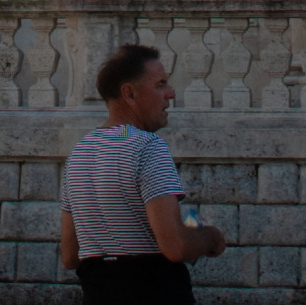
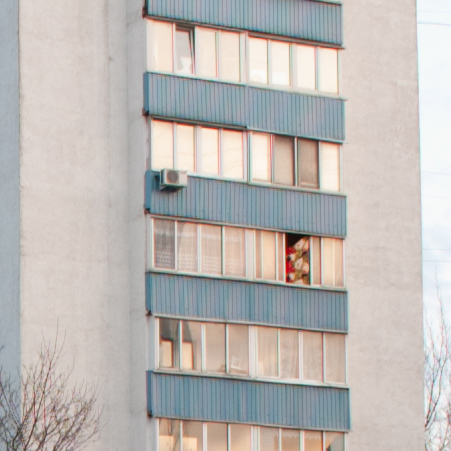

The Modern Irony: Why Razor-Sharp Glass Triggers More Moiré
Almost every current mirrorless body omits the optical low-pass filter (OLPF) to squeeze out maximum per-pixel bite. Pair that unfiltered sensor with modern, clinically sharp prime lenses—an obsession I examined in my breakdown of optical physics versus spec-sheet sharpness—and shoot a full-length e-commerce look or a wide architectural room. The lens resolves thread weave so cleanly that it collides straight with the pixel pitch.[2] In real-world interior photography, sheer curtains, acoustic panels, and textured upholstery are prime suspects; in corporate portraits and apparel work, fine worsted suit wool and patterned ties trigger rainbow banding immediately.

Post-Production Reality: Capture One & Lightroom vs. Heavy AI Pipelines
When client QA flags fabric banding and a reshoot isn’t in the budget, you have two practical ways to clean the file without tanking your turnaround time:
- The Fast Baseline (Capture One & Adobe Lightroom): For day-to-day commercial volume, built-in local adjustments remain undefeated. Both Capture One (Moiré slider in the Clarity/Detail tool or on a local adjustment layer) and Adobe Lightroom (Adjustment Brush / Masking → Moiré) strip away chroma rainbow interference while leaving the underlying thread texture intact. Brushing over a jacket lapel or sheer curtain takes 15 seconds per frame and keeps a 300-image delivery moving on schedule.
- Where AI Demosaicing Helps—and Where It Kills Margin: Neural RAW engines like Adobe Raw Details / Enhance and DxO PureRAW (DeepPRIME XD) reconstruct RGB channels far smarter than legacy algorithms, neutralizing mild chroma aliasing during demosaicing. But running full AI RAW conversion across an entire batch of 400 interior or catalog frames adds heavy render overhead and bloats DNG storage—for a problem that usually affects only a few square inches of fabric. In commercial genres where margin depends on turnaround speed, wasting hours on full-batch AI renders makes zero business sense. Worse, if over-sharp optics baked a hard luminance interference wave directly onto the photosites, no AI model can reconstruct a weave that was optically scrambled at capture. Save AI passes for hero frames; use local brushes for everything else.
The Hardware Shortcut: Why Older OLPF DSLRs Still Earn Their Keep
Field note: In still photography, I have virtually never fought destructive fabric moiré on classic full-frame DSLRs equipped with a physical optical low-pass (anti-aliasing) filter—workhorses like the Sony A900, Nikon D750, Canon EOS 6D, and Canon EOS 6D Mark II,[3] which now cost a fraction of a single modern prime lens.
That hardware protection is an engineering trade-off, not free magic. A physical OLPF intentionally softens high-frequency detail slightly before light reaches the photosites. On the original Canon 6D, its dense two-layer filter makes base-ISO RAW files look slightly soft out of the box, and pushing sharpening aggressively to compensate quickly surfaces luminance grain. On the Canon 6D Mark II, Canon used a weaker unidirectional OLPF (paired with Dual Pixel AF) that kept still frames largely immune to moiré, though its older off-chip ADC architecture limited base-ISO dynamic range—meaning heavy shadow recovery or aggressive sharpening at ISO 100–200 exposes coarse magenta-tinted noise (a quirk largely masked in 1080p video via line-skipping and Rec.709 tone compression).
Every sensor forces a choice: shoot an unfiltered modern mirrorless body (or gamble on multi-shot High-Res mode[4]) and keep Capture One’s Moiré brush mapped to a shortcut, or keep an inexpensive OLPF full-frame body in the studio for drapery, upholstery, and suiting jobs where reshoot insurance matters more than synthetic chart sharpness.
Engineering Field Notes & Camera-Specific Quirks
- Why Fujifilm X-Trans trades rainbow moiré for «worms»: Fujifilm’s 6×6 irregular X-Trans color filter array avoids classic RGB rainbow banding without an OLPF, which is why Fuji shooters rarely complain about color moiré. However, physics still applies: when fine fabric weave hits the Nyquist limit, X-Trans sensors produce luminance aliasing and maze-like «worm» artifacts during standard Lightroom demosaicing. ↩
- The on-set optical emergency brake (Diffraction Micro-Shift): If you spot moiré dancing on your rear LCD during a shoot and cannot swap bodies or angles, stop the lens down into mild diffraction (f/11–f/13 on full-frame, f/8 on Micro Four Thirds) or nudge focus by a millimeter. The wider Airy disk acts as a temporary, zero-cost optical low-pass filter on the spot. ↩
- Canon’s asymmetric OLPF & 5DS R trick: Unlike Nikon and Sony, Canon rarely dropped OLPFs completely. On Dual Pixel AF bodies like the 6D Mark II, R6, and R6 Mark II, Canon used a weaker single-axis (vertical) filter because each pixel is already split horizontally—meaning moiré can still sneak through on strictly horizontal micro-lines. The 50 MP EOS 5DS R famously used two filter layers where the second optically canceled out the first. ↩
- The Pixel Shift High-Res trap for interior and product shooters: Multi-shot Pixel Shift (80 MP on Panasonic G9 / OM System OM-1, 16-shot on Sony A7R IV/V) records full R, G, and B data at every pixel, completely eliminating Bayer color moiré on static fabrics. On paper, it looked like pocket medium format for studio and interior shooters—until real-world commercial conditions exposed the catch. On the Panasonic G9 (and Sony bodies), High-Res mode runs strictly on the electronic shutter, disables flash sync altogether, caps shutter speed at 1 second per frame, and forcibly turns off dark-frame subtraction (Long Shutter NR). One second alone isn’t long, but firing 8 consecutive electronic-shutter readouts back-to-back heats the sensor enough to litter dark lacquer and deep interior shadows with hot pixels. By contrast, the OM System OM-1 handles studio High-Res far better: its stacked BSI sensor runs cooler, supports shutter speeds up to 60 seconds, and even allows studio flash sync with a programmable charge delay (up to 30 seconds) between frames. Still, no camera performs per-frame dark-frame subtraction during multi-shot electronic High-Res—and dropping back to single-shot mechanical shutter with dark-frame subtraction enabled (which kicks in at 4+ seconds on the OM-1) doubles every exposure time and drains batteries fast. ↩