
This is about the peculiarities of interior presentations. Attached to the article is a photo session of the object, with a video. Some frames are clean, some are with AI generations. Look at the photos (1, 2, 3, 4, 5, 6, 7, 8, 9↴) and the video (↴) together with the text: they’re about the same thing.
Very, very often, even during project discussions, the topic comes up: «We’ll need to integrate people via neural network» or «We’ll change the light to a sunny day via AI.» To marketers this seems like innovation, speed, and «cost minimization.» At that moment I stop the conversation.

Freedom is what is unknown to AI. Not «forbidden,» not «unavailable» — unknown. Like a exit into another dimension. AI works on a plane: pixels, patterns, statistics. A human steps out of the plane. He comes, sees, decides. That is what a human is.
I’ve worked with generative content for years. And in working with it, there are details that must be discussed. That’s exactly why I see where these details lead if they’re not agreed upon. But that’s not even the point. I don’t want my work to leave a residue that we were doing empty work together. That’s the main thing.










Sofas with dense upholstery, chairs with washable covers, low island poufs. This fabric easily withstands wet clothes, bags, and even spilled coffee. Everything is made to the dimensions of the hall — to the radii of the walls, niches, and passageways; it’s important that no one trips over anyone.
The reception counter with a glossy copper-toned facade. Light-colored top. From the counter extends a white table of complex geometry — it continues the counter in another form: angled, sloping, on its own support. Behind the counter — a comfortable place for the registrar: monitor, lighting, cable channels hidden. The walls behind the counter — copper-toned panels.
In front of the counter — a waiting area. Dark modular sofas assemble into configurations: you can place two or you can place four. Dense upholstery.
Next to it — a bar counter with high stools by the window and a coffee point with built-in equipment. While the patient waits, they can sit at the counter, grab a coffee, watch TV. All of this is one space: registration, waiting, rest.
I work with everyone for the long haul. That’s why I think about what will happen to your brand in a year. Trends change rapidly. Just now everyone was doing AI generations — and already «Guaranteed Human» is becoming a mark of quality.
The AI industry played a cruel joke on business: the most complex algorithms became available in one click. As a result, many companies slid into the dangerous delusion that generation is simple and cheap. But if you’re building a business seriously, games with «fast AI» will cost you too much. And here’s why.
The Print Censorship of Authoritative Glossies
For any designer or architect, publication in publications like AD (Architectural Digest), Salon, or Elle Decoration is a status symbol [Aesthetics of Photography]. Today the editors of these magazines have introduced a strict entry censorship on AI. Magazines value their reputation. When AD or Elle Decoration publish an apartment or a villa, they stake their reputation that the object exists, that the tile lies evenly, that the textiles were selected in person, and that the light falls exactly that way from a specific window. By pressing the «generate» button, a marketer closes the doors to the major leagues for the brand. But that’s not about everyone? For now, yes.







Shelving partitions made of solid wood divide the hall into zones without blocking light. Built-in storage systems — for small decor and documents. Radiused reception counters and bar modules are integrated into the overall geometry of the space. Everything from one material — veneer, metal, and stone.
Between Retouching and Risk Stand Several Lawyers
Drawing light on a photo of a house from a direction where the sun physically never is — that’s not harmless. It’s a direct legal risk and falsification of a commercial offer. And a direct lie. And all our mothers teach us: «Don’t lie, son.»
We’ve reached a point where the hidden use of AI in advertising is perceived by people as deliberate deception (proof).
The global market has entered an era of strict regulation. In Europe, the pan-European law EU AI Act officially obliges the labeling of all commercial generations and photorealistic AI modifications, encouraging this with fines up to 15 million euros or 3% of the company’s global annual turnover. In the US, the Federal Trade Commission (FTC) punishes this with full severity under Section 5 of the FTC Act: if AI lighting masks defects of the object or creates the illusion of architectural lighting that doesn’t exist, the advertisement is recognized as illegal (Deceptive Advertising). And no disclaimer like «Image modeled by AI» will save the brand.
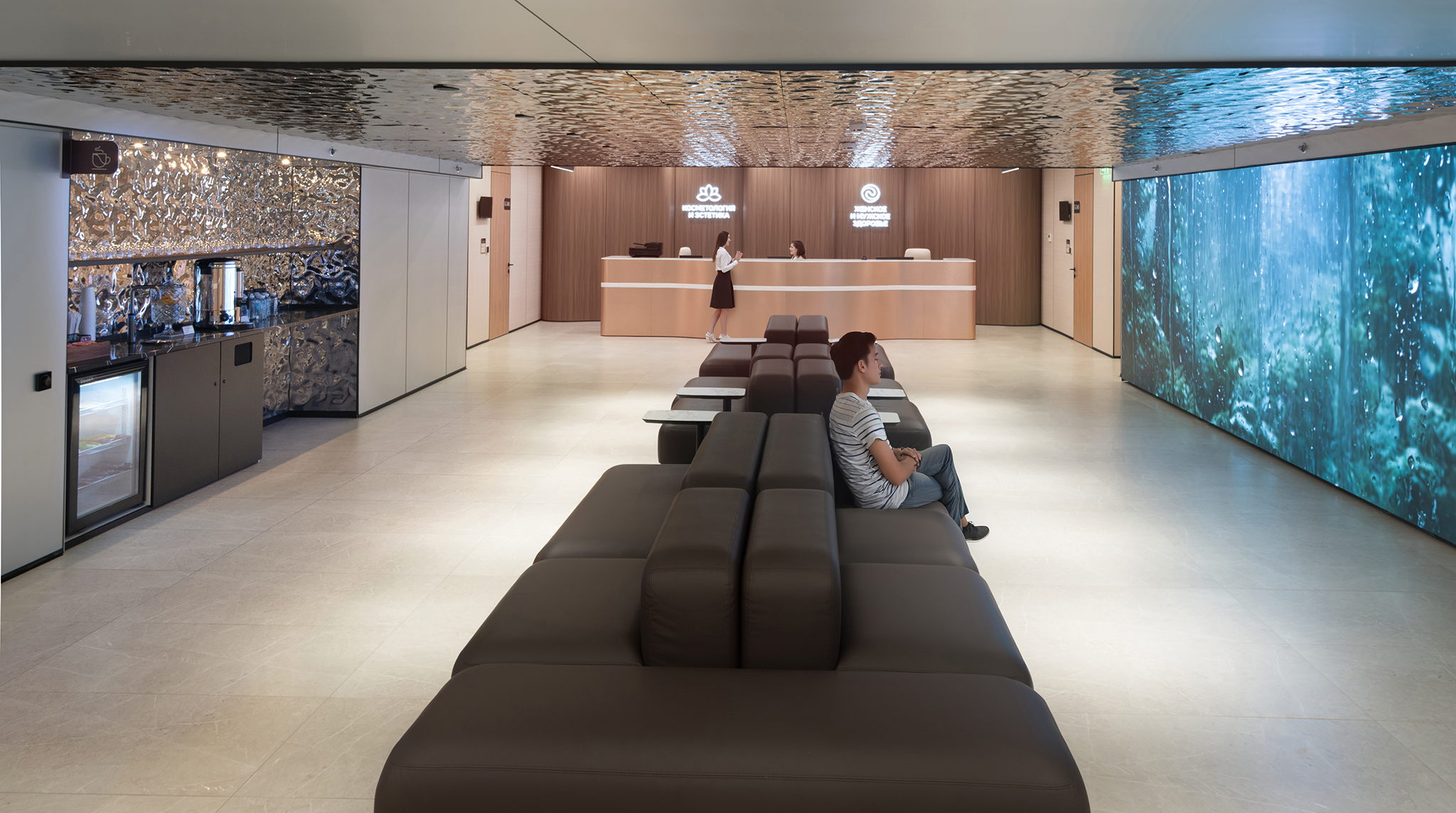
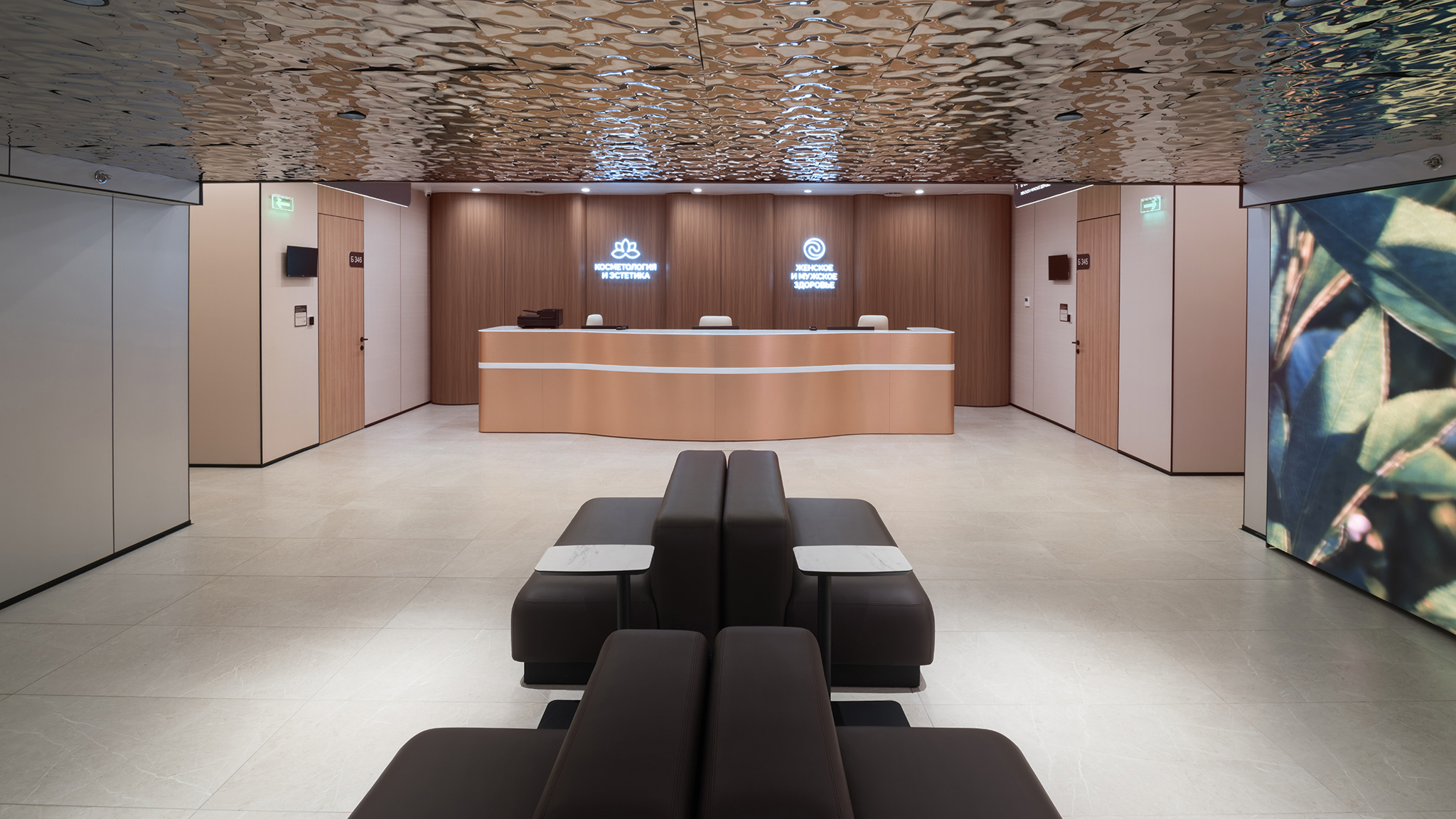

Island sofas in the center of the hall, mirrored ceiling, wave-shaped reception counter. Multi-seat sections assemble into complex shapes for a specific space. Upholstery — durable for daily visitor flow.

Two-level counters of complex wavy shape. Acrylic top, copper-toned facade with concealed LED lighting.
In Russian Realities, the Situation Is Different
In FAS practice today there is not a single fine specifically for the fact of processing a photo with a neural network, including changing the lighting Nine Risks of AI for Business | Pravo.ru (in Russian). Changing the light on a photo of a house via AI is absolutely legal. In Russia at the moment no mandatory labels need to be placed (in Russian) (draft laws on labeling AI content are still under consideration).
FAS and Rospotrebnadzor get involved when AI generation directly distorts the real consumer properties of the object. If a developer or realtor used a neural network to hide defects — cracks, crooked walls, an ugly neighbor’s fence, «drew in» a view from the window that doesn’t exist, or depicted facade lighting that the building doesn’t plan to have — the consumer will arrive, see reality, and draw the agency’s attention.
In such a case, the company will guaranteed be held accountable under Article 14.3 of the Code of Administrative Offenses of the Russian Federation (Violation of Advertising Legislation) (in Russian). FAS Russia classifies (Paragraph 2 of Part 3 of Article 5 of the Federal Law «On Advertising») (in Russian) such actions as misleading and distribution of false advertising (in Russian), since distortion of the appearance of goods deprives the client of the right to receive truthful information. But the key marker here is that they punish not for using AI. They punish for the deception that this AI created.
If you trust algorithms, for deceiving the consumer a legal entity in Russia faces harsh punishment: FAS issues fines under Art. 14.3 of the Code of Administrative Offenses of the Russian Federation in the amount of 100,000 to 500,000 rubles for each violation (in Russian). Russian courts have begun officially fining for blind trust in neural networks, creating a precedent: if a person did not check the generation, they bear all responsibility, not the robot.




Bar counter, dining tables, coffee point. Chairs get dragged here and there, legs hit the floor, underframes collect crumbs and spilled coffee. Here it’s important that in a year you don’t have to replace everything.
This Is the Main Trap
The marketer thinks: «In Russia they don’t fine for AI, so it’s allowed.» Well, yeah, well, yeah. But the risk isn’t that you’ll be punished «for using technology.» There are more risks. The neural network hallucinates, and with the increased volume of tasks, a person’s eye simply gets blurry (more on this below). Even I once, on a rush job, missed a third leg on a chair in a generated mockup…
As a result, the fine comes for false advertising. Or maybe it doesn’t come. Instead of FAS, the brand will be punished by the consumer themselves: people on social media will simply be sickened by the third leg on a chair, the sixth finger on a model’s hand, or the extra leg on a premium designer table. And this disgrace will fly around public pages faster than any paid campaign.
If it comes to legal proceedings, the responsibility will be exactly the same as if a human had invented the fake. But a sober person understands the physical structure of the object, while a neural network does not. It assembles a statistically «beautiful» mess of pixels. AI adores symmetry and aesthetics. And it’s always ready to apologize for bad work, very politely.


A chinchilla display case by the reception. A wooden cage for the chinchilla is built into a niche next to the reception. Inside — a house, a wheel, shelves, hay. Wood, not metal — because chinchillas gnaw everything, and metal kills them. Nearby — armchairs and a table for waiting. Everything is made so that the animal is convenient to observe and so that the cage harmonizes with the walls — both veneer and panels.
The Nature of a Photographer’s Work
Have you heard that «neural networks will leave photographers without work»? Relax. AI won’t destroy my career. It will destroy the brands of those who save on advertising products. Why? The answer is simple.
A photographer cannot be «cancelled» by generation, because their work is a position in the physical world: someone has to come and take the photograph. Each photographer offers their own level of interaction with the fact: angle, light, optics, moment, retouching. This is the difference between «someone came and pressed the button» and «a photographer came and shot it.»
Years make any specialist better — a locksmith, a musician, an engineer, a photographer. Because labor changes the personality — if we want that, of course. Someone can walk all their life with a parrot on their shoulder on the beach and not change. What grows is not the number of shoots, but the precision and elegance of decisions. This is not a metaphor, but the 10,000-hour rule — deliberate practice, not mechanical repetition.
AI Lowers the Price of a Frame. What’s the Trade-off?
The marketer hopes that «just adding light + people» will make the picture more effective. And indeed, the cost per image decreases.
It works. In the moment. Pressed — got it. Well, you got something. The subscription is clearly less than the fee. No more logistics and fuss around shoots. Different light, different people, different angle arise while sitting at the computer. And not five frames, but fifty.
The bosses smile contentedly: budget saved, images exist, deadlines compressed. The marketer — good job.
It’s a rational decision. That’s why people fall for it.
But this economy has a bill. The label «made by AI» reduces trust — and therefore reduces conversion. Magazines like AD don’t take such frames — and therefore the brand falls out of the major leagues. Competitors who shoot for real look more real — and therefore negotiations don’t go as smoothly. And if the images work worse, the budget for next year gets cut. Not «trust is lost» — clients, publications, position, and money are lost.
The client thinks: I’ll refuse the shoot, and if this photographer isn’t available — I’ll take another. But the point isn’t the specific photographer. Chains of interaction within the enterprise itself are collapsing: someone now sits and sends generation after generation for review, someone double-checks, someone compiles, someone is responsible for the neural network not screwing up. New jobs with new competencies appear — and they too take time, money, and people. Saving on the shoot turns into a redistribution of resources, not their release.
Previously, three to five frames were sent to an artist — to draw in decor or people. Now they want to process the entire photo session: thirty, fifty, two hundred frames — in one style, with decor and people. And then choose where it worked. But this works «so-so.» You don’t hit the bullseye by accident. But everyone works up a sweat.
But it’s not just about the result. There’s no mastery in prompts: tomorrow the model updates, and yesterday’s formulations stop working. Mastery doesn’t accumulate, because the tool changes rapidly.
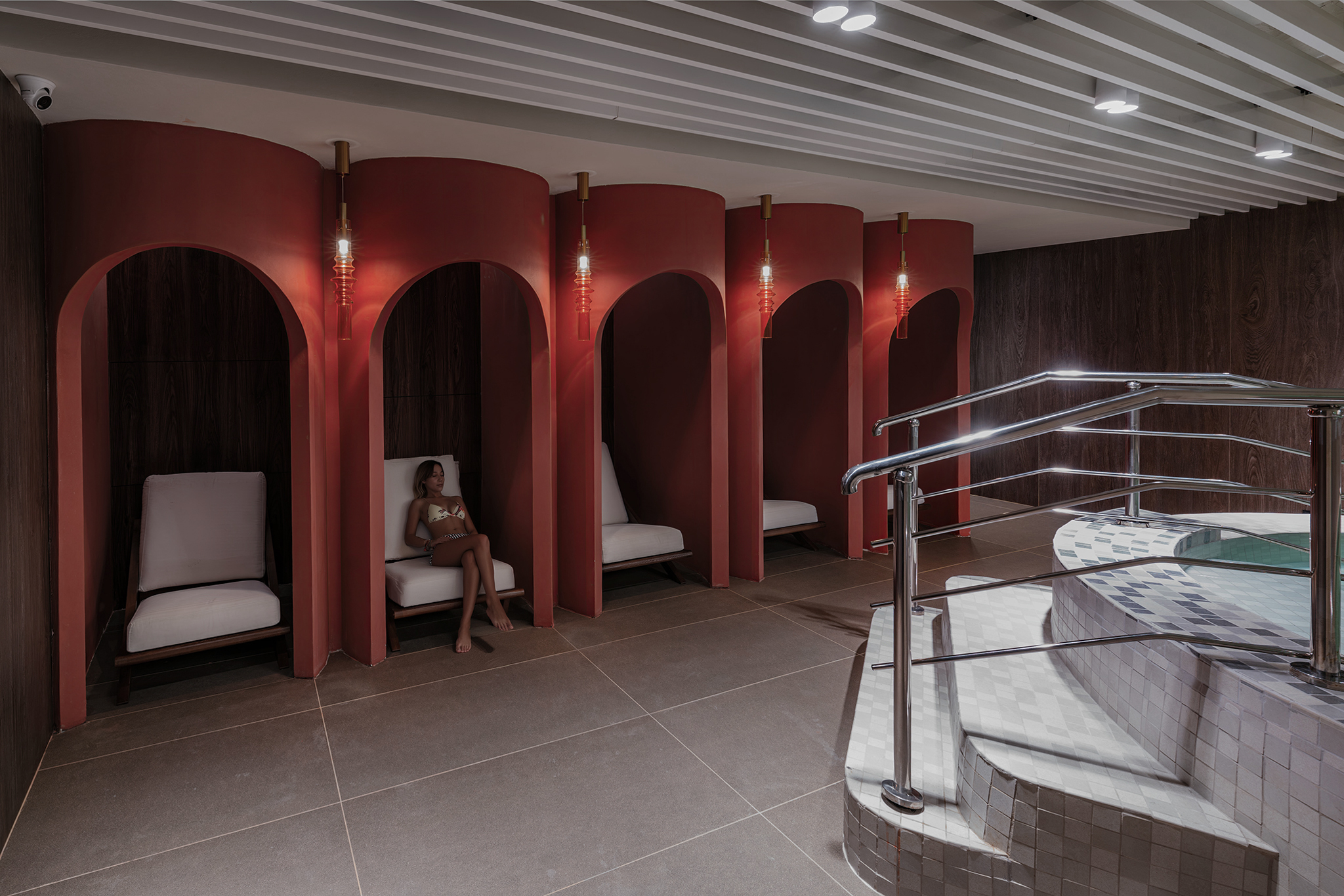
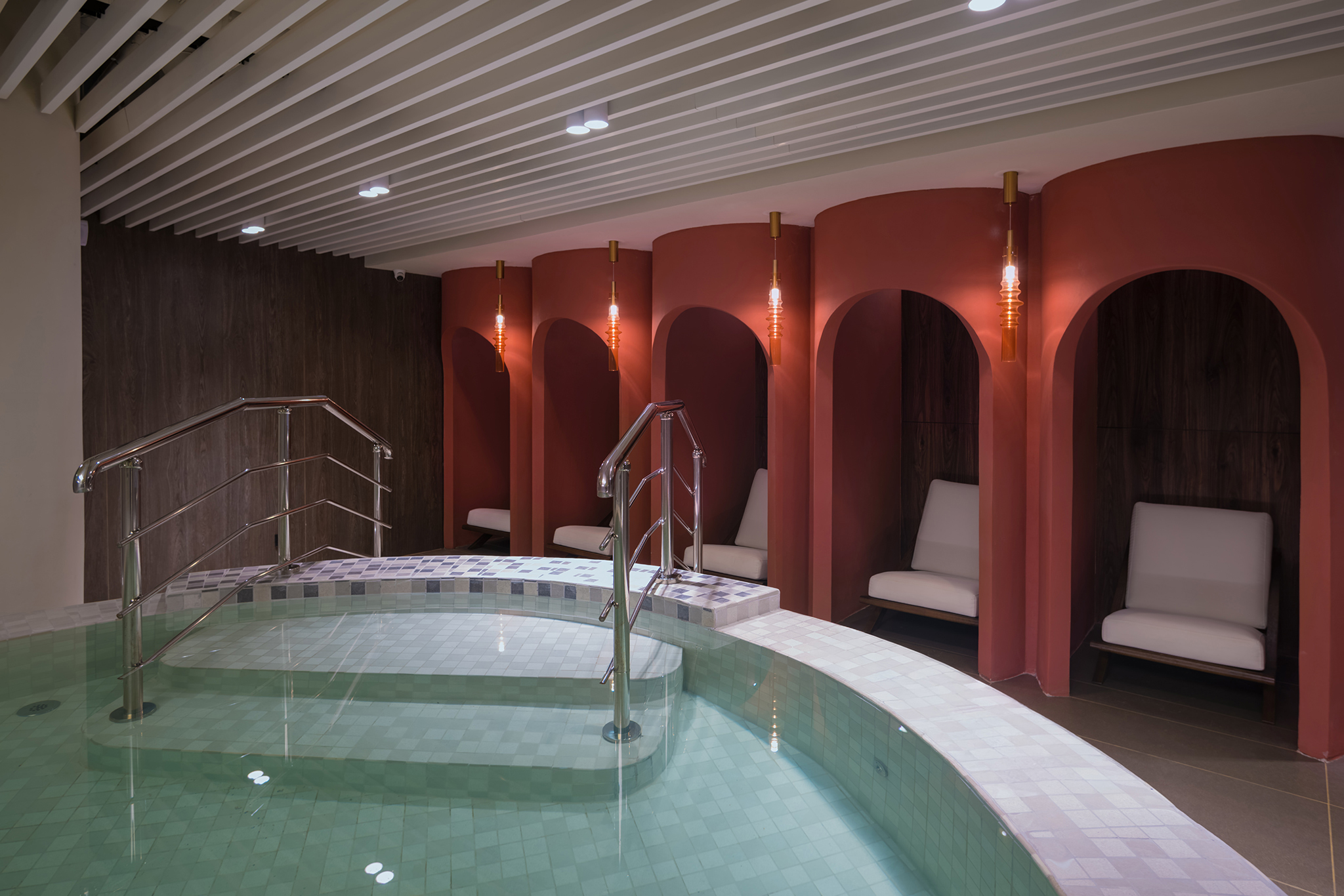
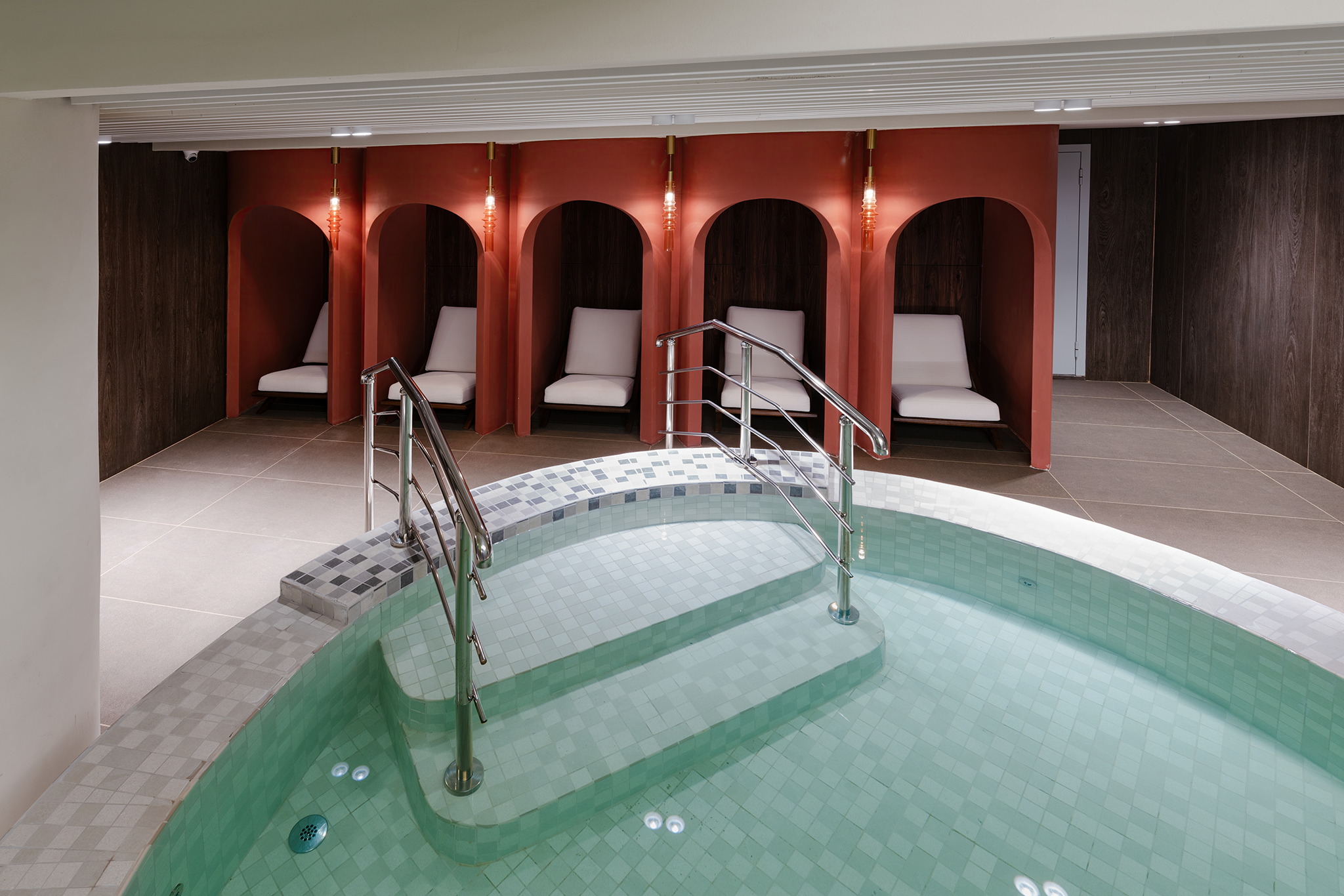
Loungers in arches, moisture-resistant upholstery, materials that steam and water don’t frighten. Here it’s always wet: after the pool, after the shower, after hydromassage. The furniture withstands it. Moisture-resistant — won’t swell or become stained.
That’s why this is a short bet. It wins the day. But loses the year. A short bet is good for short ventures. For everything built for the long haul, it doesn’t work.
Why Is the Consumer Tired of AI? — and Why Does This Change Everything?
As a large-scale international study by The Harris Poll and Infillion shows, the audience has staged a real boycott of hidden AI marketing:
- 78% of consumers believe AI reduces the authenticity of advertising. The same number call brands «cringe» if they use AI too actively.
- 73% reduce trust in advertising if they feel it was made by AI. 63% — are less inclined to buy from such a brand.
- 54% say outright: «I hear a lot about AI, and it annoys me.»
- 70% of consumers claim they can identify AI advertising because it’s «soulless.»
- 74% are more inclined to buy from a brand whose advertising is made entirely by humans. 87% say the best advertising still requires human participation.
- 50% of American consumers would prefer to do business with brands that don’t use AI in consumer content.
Gen Z is the harshest: 39% view AI advertising «very or somewhat negatively.» This is almost twice as much as millennials, and almost twice as much as two years ago (then it was 21%).
This is not an «opinion.» This is a shift.
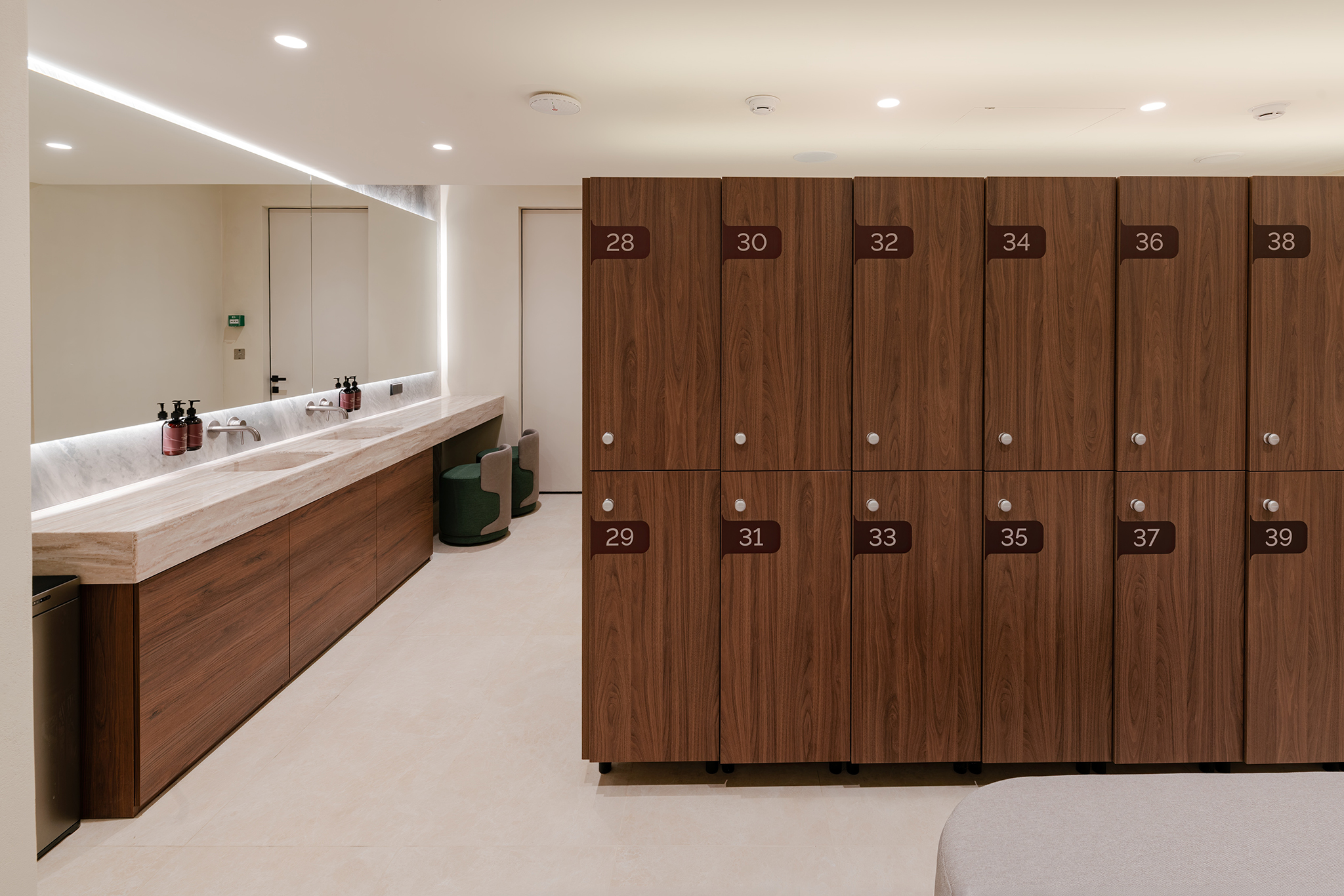
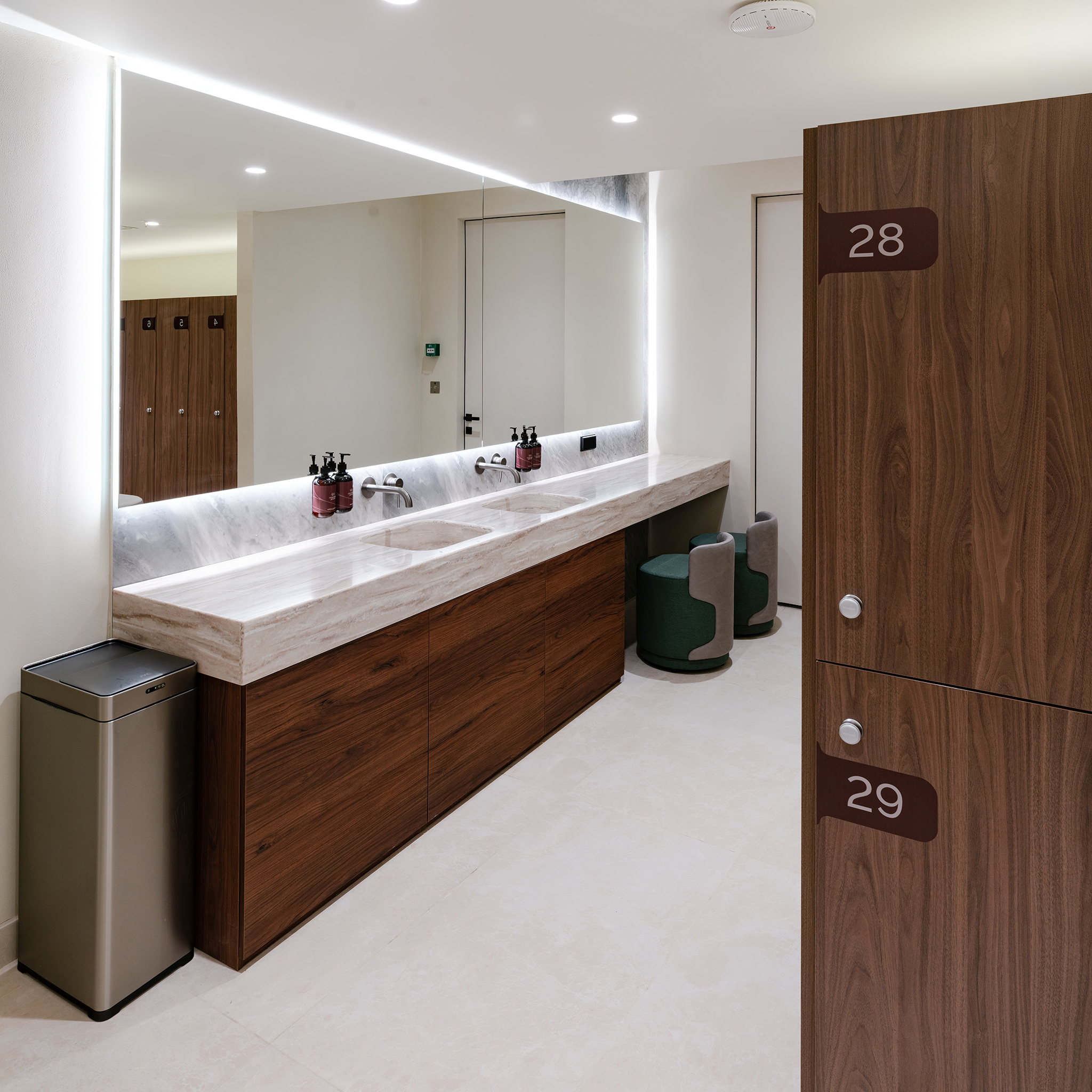


A long suspended console with a stone countertop and two integrated sinks. Chrome faucets, black soap dispensers. Mirrors with contour LED lighting. Under the console — green-gray poufs for changing. Very convenient.
Personal sectional lockers made of moisture-resistant MDF with numbers.
About Cats…
More and more often, marketers, when trying to «bring their projects to life» via AI, slide into cats. The reason is that an AI human is frightening. And an AI cat — it’s just a cat.
It’s all about deep subconscious rejection. People instantly read a «almost-human» as wrong. Facial expressions, dead gaze, micro-gestures — AI can’t do any of this and, contrary to myths, is unlikely to learn because of the very specifics of generative algorithms (for those interested in the technical side — read the big breakdown on Medium). And it’s frightening. Scientific experiments in a Harvard Business Review study proved: advertising with AI people lowers emotional engagement and loses to live frames, even if the viewer can’t directly articulate what repels them.
Cats-dogs-mice easily dance around this problem. Research shows: pet influencers surpass human ones in trust and everything that follows. Why? Animals are perceived as sincere. They «have no hidden motives.» They don’t try to be human — they just are.
Official figures for the effectiveness of animals in advertising are recorded in a marketing report from Insider Intelligence and Foundry on Foundry CRO — according to this data, creatives with animals give CTR up to 3%, while average figures are 1.1–1.5%. Cost-per-engagement for pet campaigns is 2–3 times lower.
Marketers feel this intuitively. And they switch to what AI does better — to non-humans. Cats. Dogs. Abstractions. Products without people.
But a cat — it’s not about furniture, and a lot of things are «not about the cat.» A cat is a quiet rasp: «I couldn’t do a human. Take a cat.»

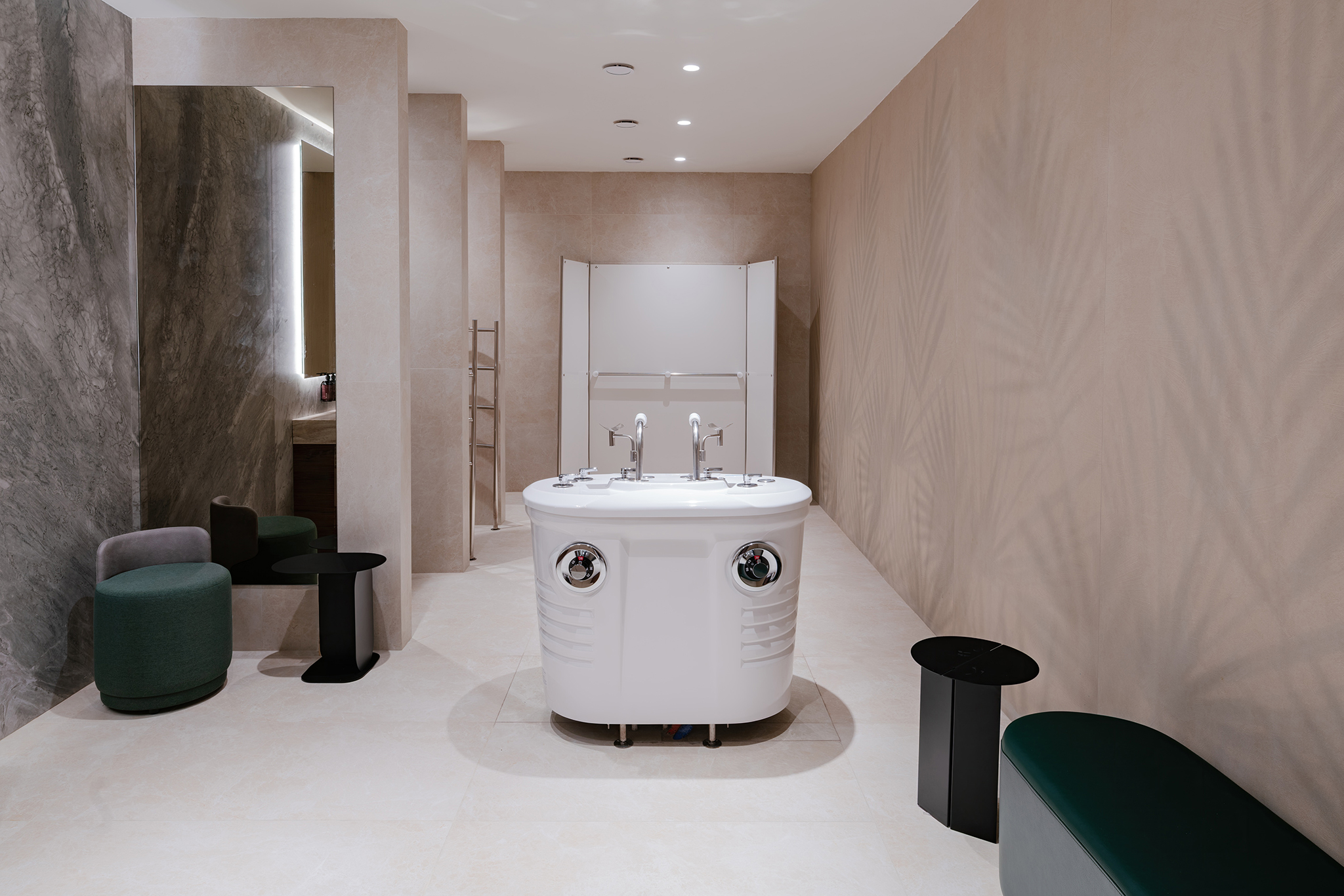
In this room, there’s an installation with two chrome nozzles on the body, the patient stands nearby, and water jets are supplied under pressure to the body. Used in physiotherapy, hydrotherapy, rehab rooms. Haven’t seen one in a long time.
Act 2. Anatomy of a Hallucination: Why AI Is Blind to Physics
The generative content industry has created an illusion: any fifth-grader can take a ready-made base of photographs and write a simple prompt.
Well, if, for example, there’s a task — 50-100-500 frames of a photo session to fill with decor and people, the first thing a smart person does is try to write a «general prompt» for all the photographs and run them through it. You really want to automate. And here’s the catch.
One prompt for 50 photos — that’s 50 different results. The neural network decides anew each time: different people, different clothes, different poses, different light. In one frame — suits. In another — sweaters. In a third — it’s unclear what at all.
Because a «general prompt» doesn’t work. You need to write a separate prompt for each frame, or at least try to group them, and work in groups, which is also debatable. You need to consider where we want to place people and objects, what they’re doing, what light, what angle. And then — check what came out. And then — redo it. And then — redo it again. Because the neural network produces a new result each time. And this result doesn’t match the neighboring frame.
Three days will go into this. For sure. And most likely — four or a week. And if a marketer is doing this, all this time they’re not doing marketing. They’re doing this. Because the neural network doesn’t know your object, doesn’t know how the items are used. It knows «an object in general.»
You need to act on each picture separately, and preferably also in zones. And here the task of «just pasting people into 50 photos» becomes no less labor-intensive in time than an artist’s work with 5 images. And the result, of course, is different.
By pasting human figures or changing lighting «in one click,» AI hits three main blind spots that are instantly read by the human brain as fake:
Optical Lies and the Death of Geometry
In interior photography I use Tilt-Shift lenses, or transformations in post-production. This allows me to perfectly straighten verticals, fix geometry, and remove spatial distortions. Ultimately this works to correctly direct the viewer’s attention. The neural network doesn’t even suspect these laws of optics. The outcome of its activity will be debatable.
Impotence in Real Ergonomics
Yes, you can achieve an acceptable picture through repetitions. But not perfect. But strange. And the viewer’s brain instantly reads this fake.


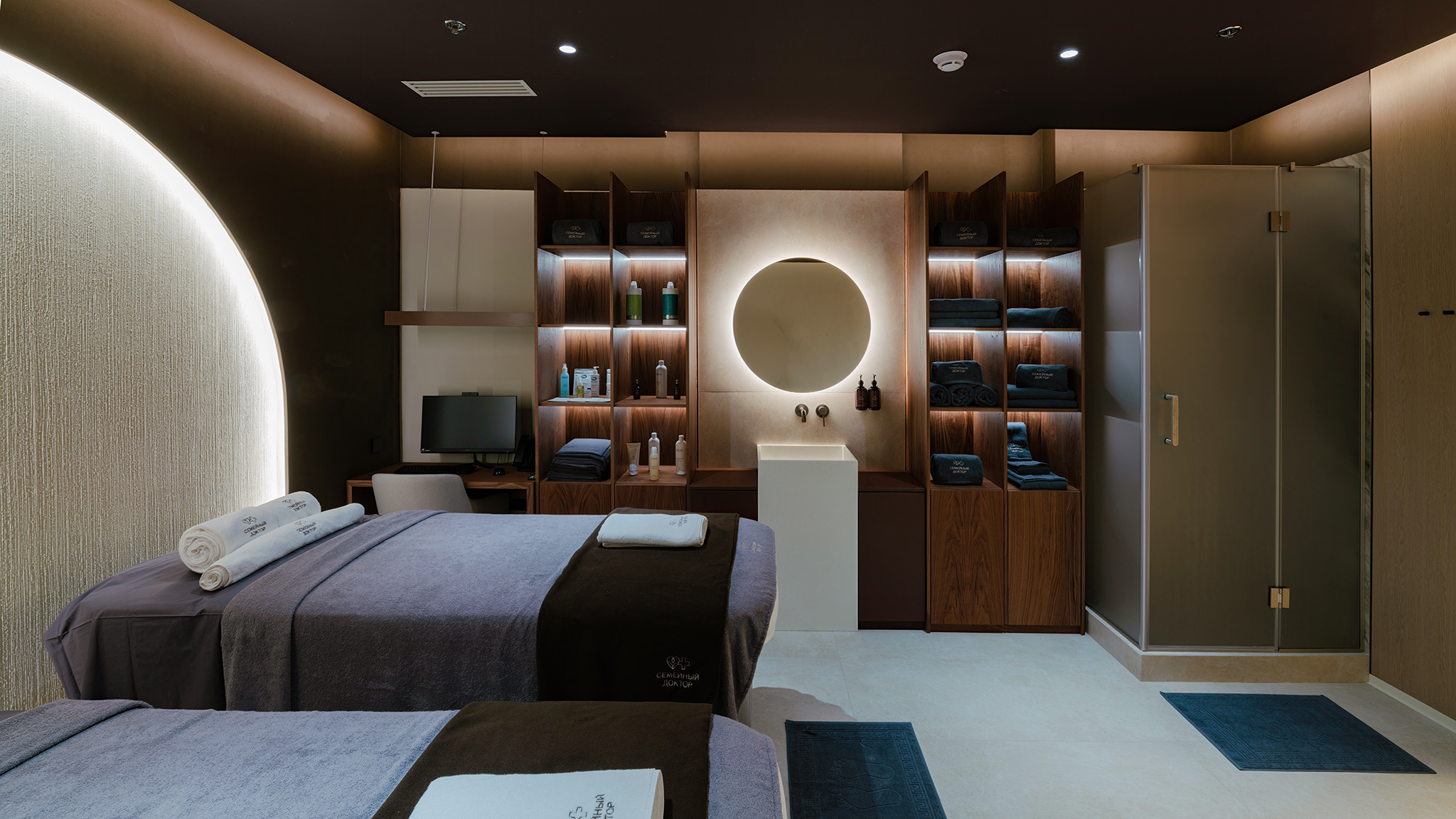

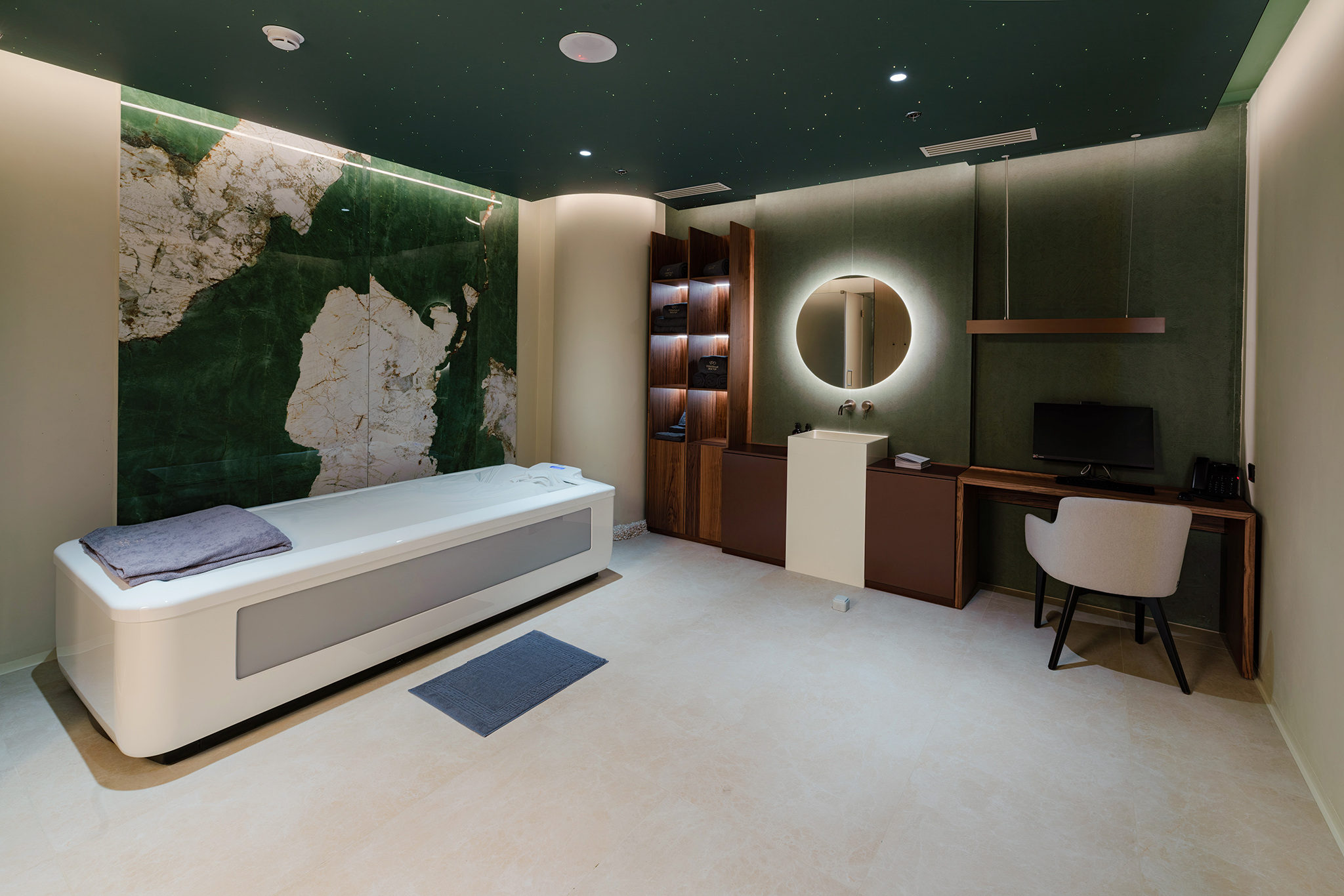
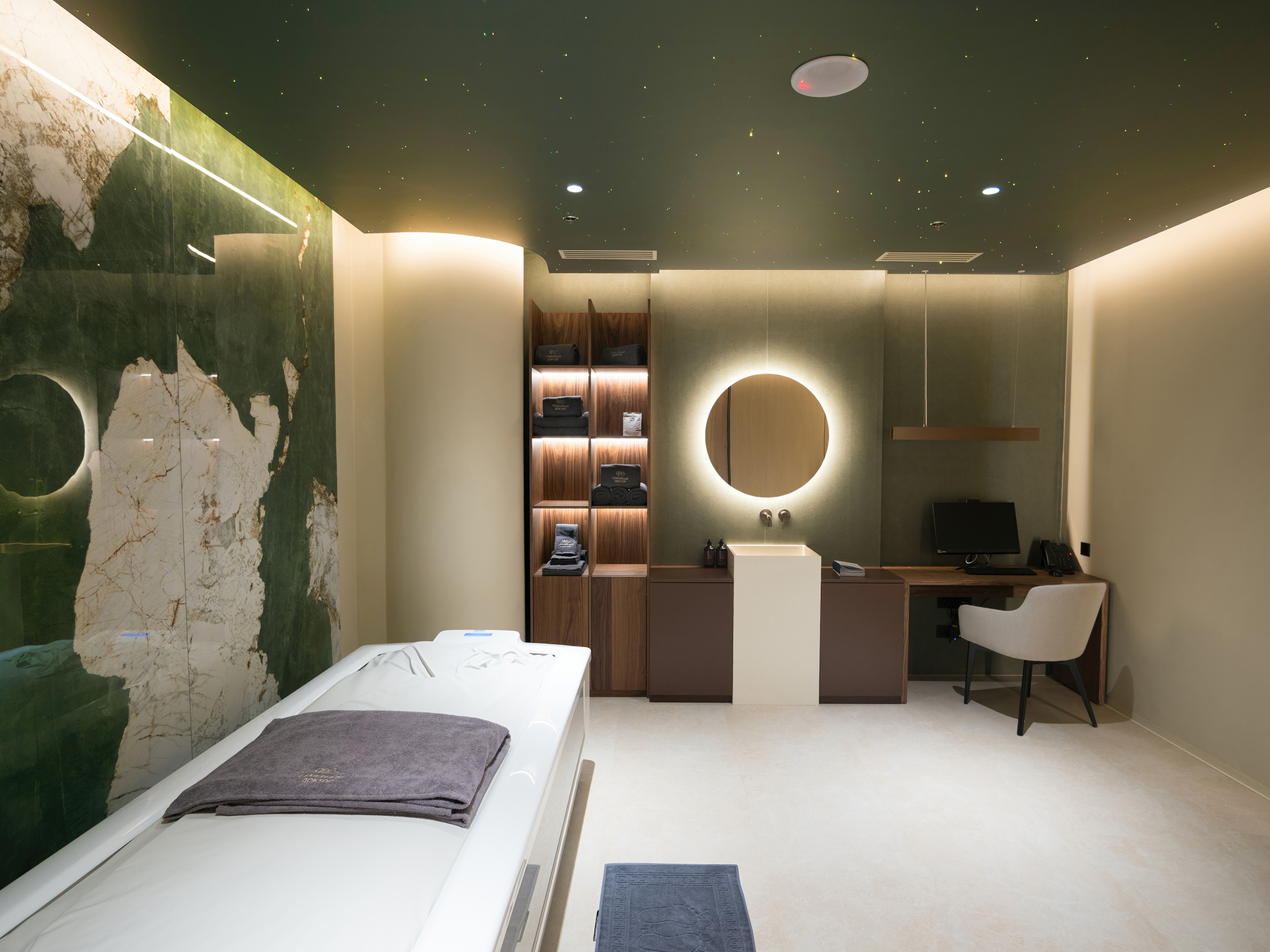

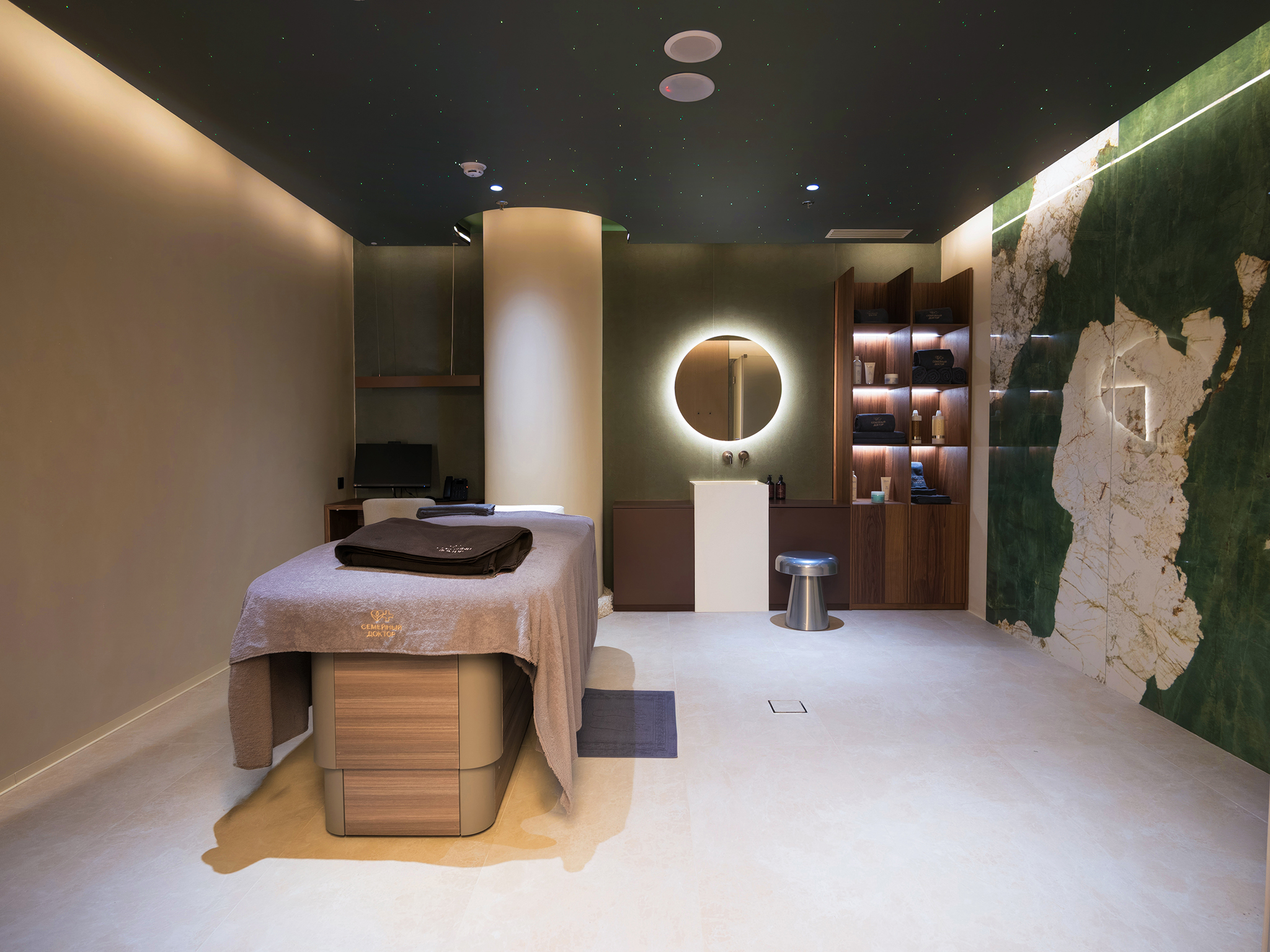
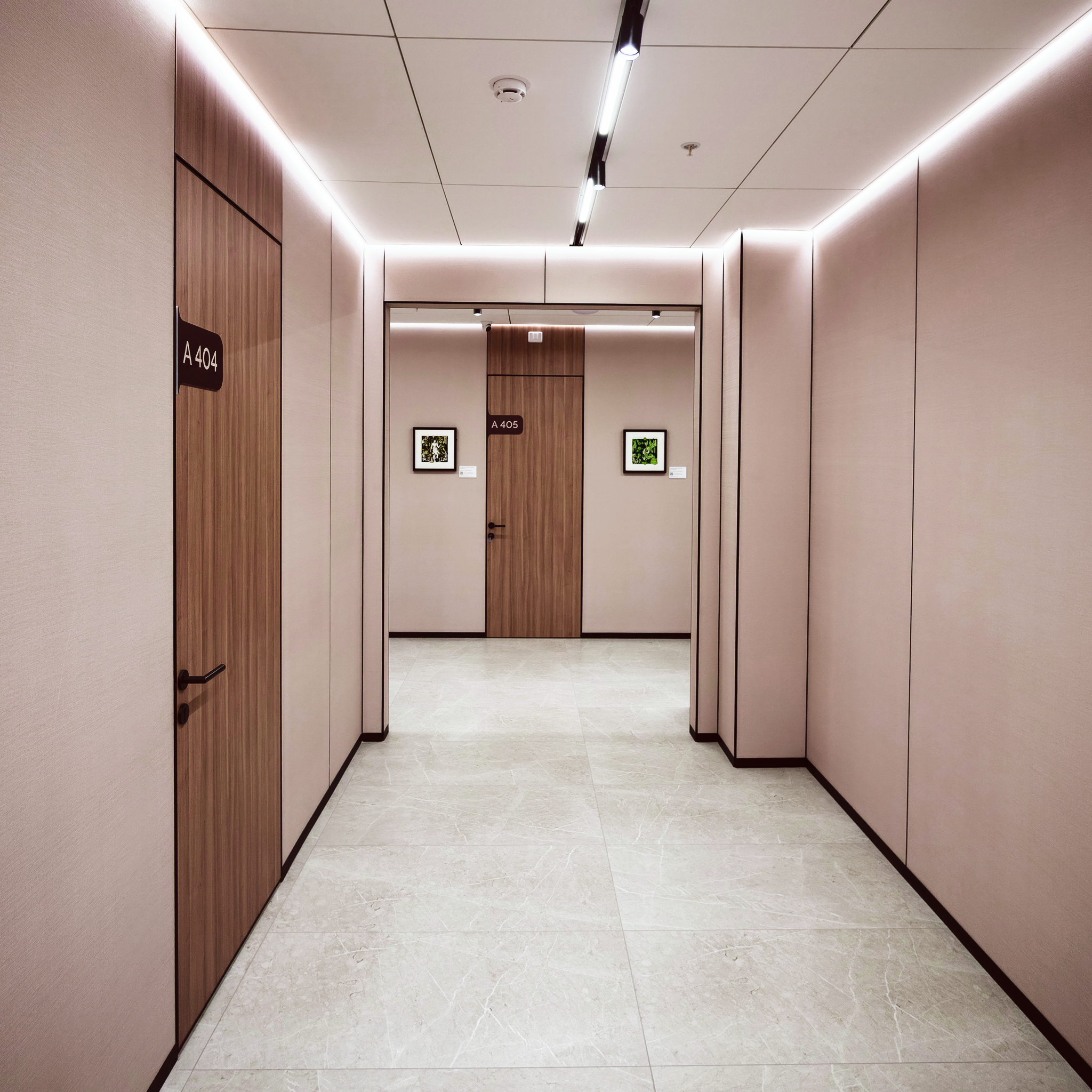
Cabinets with lighting, doctors’ desks, couches. Everything at hand. Surfaces smooth — wipe and move on.
Texture Deception and «Furniture Suicide»
When a manufacturing factory or developer commissions a shoot, it’s important for them to show various features and the overall form. The client pays for the artistic fixation of the texture of a specific material.

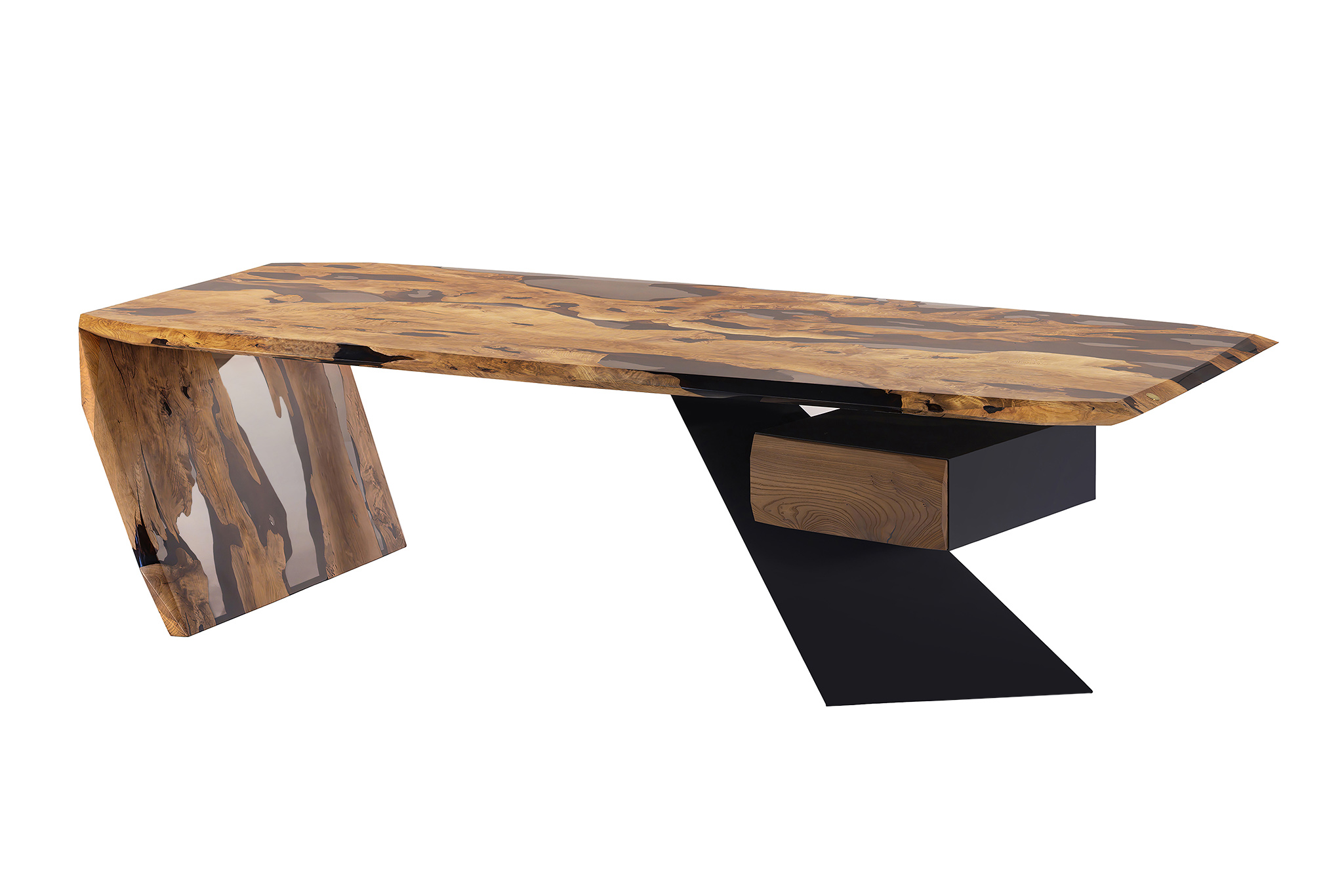
And here a fundamental dead end arises when you want to generate another angle based on a photograph. First, AI doesn’t know what your sofa or dresser is made of; second, it doesn’t have a 3D engineering drawing and doesn’t understand the construction. If your items are even somewhat «original,» an attempt to change the angle with generation will lead to a «mess.» It knows nothing at all except similar patterns. If you’ve invented a new table shape, that’s already a miss for AI.
The neural network selects statistically probable pixels, creating a fictional object that only superficially resembles yours. This is a great idea if you need to make a sketch for an idea, but not a photograph for promotion. According to furniture market statistics, more than 22% of returns of expensive furniture happen because the beautiful picture doesn’t match the real construction of the item, and 80% of deceived buyers never return to such a brand. This is «sort of» a catastrophe.
A similar story happens with «quick sunsets» (Day-to-Dusk functions in one click). Realtors take a daytime frame of the interior and force AI to simulate dusk to save on evening shooting. But it’s not about the quality of graphics, but about the laws of physics. AI can’t calculate real optics: it’s incapable of honestly recalculating the complex re-reflections of evening light inside the interior, doesn’t know how this light refracts in the glass of the facade, won’t light the real concealed LEDs on the reception, and won’t create a soft, honest gradient on the wood from the setting sun. It simply doesn’t know how this house will look in the evening. Even if the picture is ultra-sharp, the output will still be a house that’s similar but different in details. The buyer’s mind reads this optical forgery.
What Actually Happens When a Marketer «Just Adds People»
When a marketer decides to «quickly add people via neural network,» they don’t get a result in one click. They get a process. Which takes their time away from marketing. And a pile of photographs — with their own defects.
Prompt: «two Europeans working in an office.» What comes back?
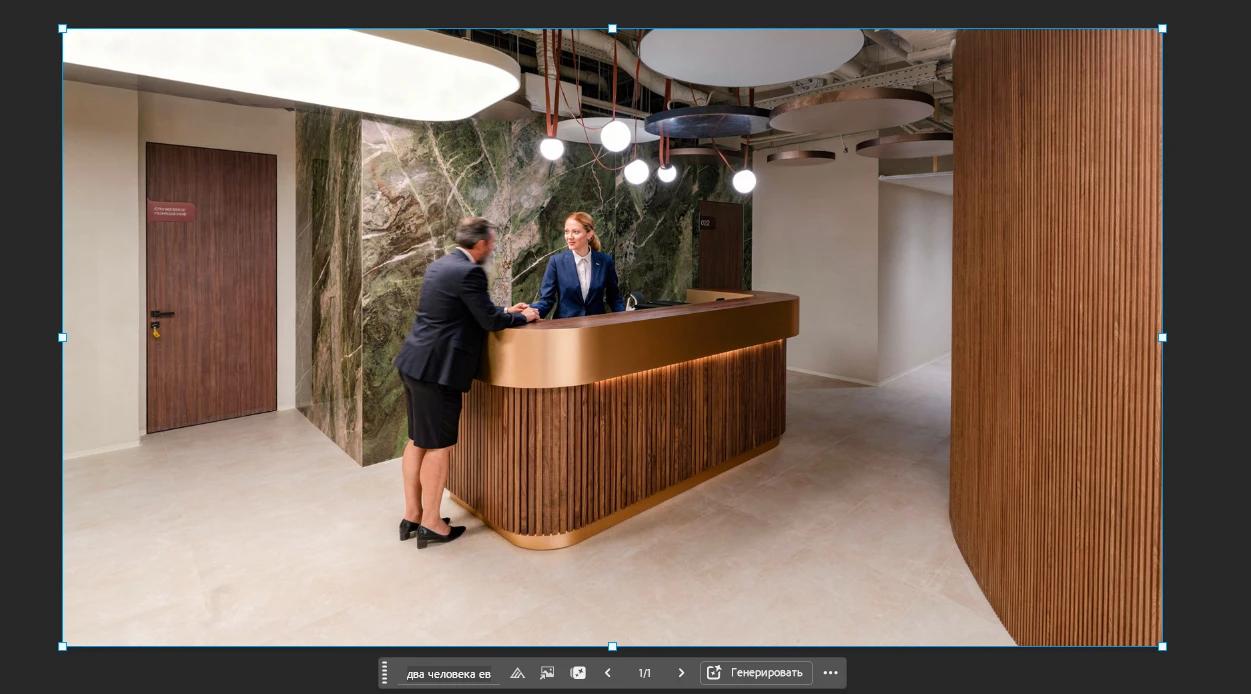
Here we get — a man in a skirt. Not trousers, not suit pants. A skirt. A straight, dark, knee-length skirt. The second character — a mannequin woman at the counter. Without facial expressions, without a gaze.
And so the marketer sits. For an hour. And could have been thinking about strategy. But they’re already tired. They twist the prompt. Change formulations in Russian, English, try different models. Achieve «more or less tolerable.» And then come to me and say: «Listen, can you do this?»
And I say: «Sure. But not via neural network. Via camera. Because the camera will put trousers on the guy. And you’ve already spent a workday on nonsense and taken some painkillers.»
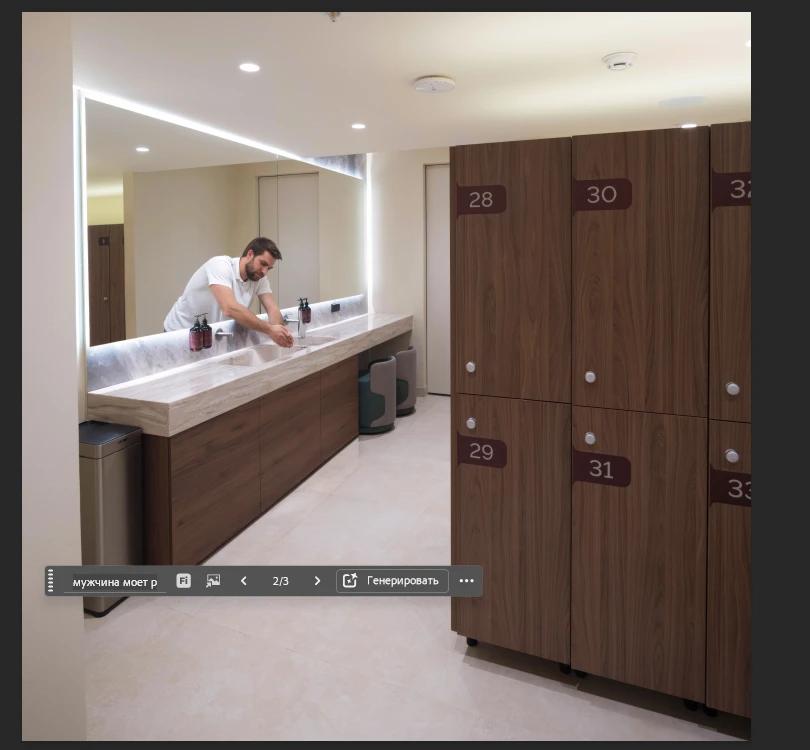
A separate story: the frame with a reflection. And a frame with a person’s reflection is a death sentence. Prompt: «a man washing his hands in front of his reflection in a mirror.»
This is not «bad AI.» But you can make a good public page with jokes out of it.
Why a Staff Artist Is Out of the Game
If the flow of generative tasks were regular, the firm would keep a professional illustrator on staff. And they would draw professionally and stylishly. On the whole, it wouldn’t come out to cosmic money — especially compared to the millions in losses from cash flow gaps and failed advertising.
But the real volume of tasks for a firm rarely justifies this hire. Bringing an interior frame to life or changing the light is a one-off, jeweler’s task that arises «sometimes.»
And that’s exactly why the marketer is left alone with the prompt line. They spend working hours of their life cycling through generations and still get something. Why? Because the budget for a live illustrator or photographer isn’t given by management. After all, they’ve already allocated budget for a corporate subscription to Midjourney, ChatGPT and God knows what else. The circle is closed: subscriptions bought, tool doesn’t work, marketer burned out, and the brand emits visual garbage.
Why Even a «Tolerable» Result Doesn’t Work
And here’s the main thing. Even if the marketer, having gone gray at the screen, achieves a «more or less tolerable» frame — it still won’t work. Because it’s not about resolution or pixels. It’s about the general, deep unnaturalness of the picture. Women, by the way, read this fake on a subconscious level much faster and more sharply than men. And the resulting rejection is always stronger than any, even technically «imperfect» frame. Because an imperfect live frame is honest. And a polished AI picture is a lie.
The only thing that still somehow saves generations is blurred figures of people in motion. A smeared trail masks what AI doesn’t have and can’t have: micro-expressions, a genuine gaze, and natural gesture. Everything that makes a human — human.
Act 3. The Anti-AI Trend and Cryptographic Proof of Authenticity
The generative explosion led to a tectonic shift in the market: the consumer is frankly sick of idealized faces, glossy portraits, and plastic plots of neural networks.
Once, even before AI, Yegor [Letov] sang: «The plastic world has won / The mock-up turned out stronger.» But today he would be glad. The locomotive is going back.
Because of this, I, an interior photographer of a high level with experience, found myself under attack… from my own flawlessness. The paradox is that a polished, sterile frame can today easily be confused with generation by social media robots, search algorithms, and even clients themselves. And this is a complete challenge for my business, and it’s invigorating.
How brands of world level are right now building a visual strategy on organic imperfections is described in detail in the review Imperfection Design Trends on Jarsking.
Today I’m learning to compose a frame in a new way. To prove the authenticity and value of a frame, I must deliberately introduce into it what a machine can’t do — controlled destruction of symmetry, the breath of life, honest physical refractions of light and air.
The struggle for authenticity has gone so far that a movement for labeling content «Guaranteed Human» has appeared on the global market. Major media holdings are already officially introducing such programs, completely banning synthetic content to preserve audience trust (more in the official statement on LinkedIn from iHeartMedia). And this is already harsh engineering reality:
Cryptographic Passports for Photographs
Camera manufacturers (Sony, Canon, Leica) have begun embedding hardware chips supporting the cross-industry C2PA standard into their professional cameras. The full and regularly updated list of equipment that embeds a «digital seal» right at the moment of shooting can be found in the C2PA Viewer database.
Protection from Surrogate
This chip permanently, right at the moment the shutter button is pressed and light is captured by the matrix, generates a unique digital signature. How this hardware-protected lock works is explained in a technical breakdown on Capture Magazine. The cryptographic passport includes everything: exact time, geolocation, camera model, and a guarantee of pixel immutability.
If a marketer takes my clean frame and rewrites it via AI (adds people or repaints the light at random), this cryptographic passport is instantly annulled. For business this carries direct losses: search robots (including Google) actively train their algorithms to identify low-budget generated content created without real human participation, and mercilessly demote it in search results for «scalable spam» [Does Google Penalize AI Content? What the Data Shows — Frase.io]. The search engine’s official rules for combating this flood of automatic garbage can be studied on Google Penalty, where it’s clearly shown how sites lose organic traffic for surrogate manipulations.
But there’s proof that needs neither chip nor algorithm. Video.
A photograph can be rewritten and animated into a movie. But if the video itself is shot in such a way that you can see: it was actually shot — another law works. Video retouching is expensive and leaves traces. Forty seconds of live movement — that’s the physics of the object.
Honest, physical authenticity of a frame has today become an elite product. For authenticity, serious business is ready to pay many times more than for terabytes of free neural network pictures.
Act 4. Manifesto: A Concert on the Ground
Analytics of the advertising and architectural markets claim that today more than half of companies have fully switched to hybrid AI rendering. They shift focus toward virtual storytelling. The data is described in the industry report Chaos & Architizer Report — according to the report, most visualization studios use algorithms for total acceleration of streaming content.
So what? The economics of this process is simple: I don’t need to try to «foist» my work on clients who don’t need real photography. Let them stay in their world of plastic pictures. Large, serious business quickly realizes the difference.
Clients come to me who need real photographs of real, completed objects. Why? To show the market, investors, and competitors a solid fact: «We actually build these objects. We actually supply this premium furniture. We are admitted to big money, we are real players on the ground, not fantasizers who render secondary garbage.»
Of course, I, as a photographer with a long artist background, am technically capable of carefully arranging decor in a frame or drawing in figures. In one-off cases I do it myself. But this cannot be a mass conveyor «in one click.»
If a brand nevertheless makes a strategic decision to pointwise integrate people into the interior via neural networks, this process must obey strict technological standards, not spontaneous experiments. AI integration without losing the status of the product is built on four basic rules:
- Local non-interference. A frame is never processed as a whole. There is jeweler-like, piece-by-piece integration of figures via masks using Inpaint technology — a professional breakdown of local editing technology can be studied in the guidelines of Adobe Design Insights. Every step is controlled so that the details of the client’s furniture remain 100% authentic.
- Regional authenticity of faces. Base AI models are trained on American or Asian datasets and produce sterile faces alien to the Russian world. The task is to ensure that generated people correspond to the client’s region of work.
- Aesthetics of motion against AI plasticity. AI models still can’t perfectly render facial expressions in dialogues, eyes, and fingers. Making them static in a commercial frame means putting technical defects on display. Characters should be integrated blurred in motion (motion blur). This masks the imperfection of algorithms and turns a «dead» picture into a live, breathing frame.
- Compositional hierarchy. Generated figures are just a touch in the background or middle ground to emphasize scale. They are categorically forbidden from being inserted in the foreground. The main hero of the shot always remains the architecture and unique construction of the furniture.
Every mature professional earns money on what they have the best specialization in. My small business is built transparently: I take a clearly defined number of orders per month, perform them with quality, and deliver. I fundamentally don’t take super-large objects like international airports — a big order carries colossal risks that a network production must bear. Only it can take on feeding dozens of models, transfers, etc., counting on payment of the contract in six months to a year.
In the same way, it’s not profitable for me to take a penny order and spend weeks clearing up someone else’s AI manipulations. It’s important for me to grow specialization, not drown in others’ non-core tasks — because it’s a broad client base that stabilizes the business.
Of course, techno-optimists may object: «What if in the future an anthropomorphic android with a camera is simply sent to the object, and a remote operator controls it from home?» But let’s take off the rose-colored glasses and calculate the profitability. Although there isn’t even a decent robot yet. For a robot to safely move across the parquet of a premium interior, jewel-like set tilt-shift lenses, and manually adjust folds on textiles, the cost of its development, delivery, and insurance must be cosmic. All this is still «so-so.» And in 20 years we’ll see.
We’ve come to a new time. It’s a time very familiar to musicians who encountered streaming. Today the price of the work of any artist, painter, or photographer is their direct «live performance.» I came to the object, worked with my legs, eyes, and experience on the ground — and delivered a product that can’t be faked on servers. Whoever isn’t ready for this — will fly out of the market. Discussion of this harsh division of the industry into a conveyor of renders and live masters can be read in discussions on [Fstoppers]. What will remain are faceless render factories and live masters who contact reality.
Why won’t photographers like me die out? For the same reason professional electricians and plumbers are needed. I contact reality. There’s no automatic mechanism that will come to the site, assess the subtleties «on the ground,» and choose the best solution.
Woe when the cobbler starts baking pies, and the pieman starts cobbling boots. In the AI era this classic has acquired an ominous commercial meaning. My task as an interior photographer is to provide the client with an impeccable, clean, professional base. A foundation. Making a passable shot for a fleeting report today really can be done by anyone on an ordinary smartphone — and for the company’s internal tasks that will be enough. But if a business needs the best strategic solution for promoting a product in a highly competitive market, it needs a professional whose work is many times more expensive than simply renting their camera.
Writing a well-known three-letter word on a fence can be done by any amateur. The letters will be the same, and the tool is available to everyone. But writing «Dead Souls» is a fundamentally different level, requiring the deepest understanding of psychology, composition, and market laws. The tool is the same for everyone — whether keyboard, camera, or prompt line. But the output for business turns out diametrically opposite.
Because a premium brand creates tangible, physical values on the ground. And when a marketer tries to substitute them with a surrogate, they summon into the world only «dead souls» on servers — fake people with plastic faces and empty gazes, in which the consumer no longer believes. Technologies will change, but genuine mastery and honest physical fact will always remain in the major leagues.
Afterword: San Sanych and the Light You Can’t Draw
There was a photographer — Alexander Slyusarev. San Sanych. In professional circles he was simply called SSS.
He shot on film, on a Rolleiflex, black-and-white squares. No effects, no gloss. Just light, shadows, reflections. And there was a phrase that the master Igor Seleznyov said to him when he was still a kid: «Oh, you see the light!»
That’s everything. Slyusarev saw light where an ordinary person sees emptiness.
Why I Remember Him Now
We’ve analyzed why AI is blind to physics. But those were technical reasons.
Slyusarev understood this. He shot the light that lives in space. And that’s why his frames can’t be faked.
What This Means for Shooting Today
Previously photographers cut off all glare with a polarizer to zero. To make it «clean.» So that the wood texture was perfectly visible. So that there were no reflections, no «garbage.»
Now this is a mistake. Because it’s exactly this sterility that AI strives for. It adores matte, flat, ideal surfaces without glare. They’re easier to calculate.
A live glare is the signature of reality. A complex reflection in glass, on a glossy floor, on a mirrored ceiling — that’s what AI can’t calculate. It draws the reflection «approximately.» Remember that mess of glowing letters on the countertop? That’s it.
Slyusarev didn’t cut off glare. He controlled them. Left exactly as much as needed for the object to breathe.
And One More Thing
AI always strives for the «ideal» frame.
Slyusarev shot imperfectly. He cut off the corner of a building. Showed a fragment — just the reception counter and the shadow falling from it. And this fragment said more about the space than a full panorama.
Because imperfection is life. And ideality is formalin.
What to Do
Don’t chase the «ideal frame.» Don’t cut off all glare. Don’t fear the fragment. Don’t try to stuff everything into one frame: shoot light, texture, reflections, air.
This is what AI can’t do. And this is what business pays money for.
Slyusarev died in 2010. But his method — to see the light — is today more relevant than ever. Because around us there are more and more «plastic pictures,» and less and less living light.
Sources and Footnotes
- [Aesthetics of Photography] — Understanding the Authentic Photography and Anti-AI Movement. A professional manifesto of the movement against artificial gloss. ↩
- [Medium Photography Analysis] — AI, Photography, and the Trust Crisis. Analysis of the fall in technical quality and the destruction of trust when original optics are replaced with generative tools. ↩
- [Clutch Co. Research] — 53% of Consumers Are Less Likely to Buy From Brands Using AI on Social Media. A global study of consumer trust in brands using hidden AI generation in advertising. ↩
- [Adobe Design Insights] — Generative AI and Architectural Spatial Composition Standards. Principles of composition and integration of AI characters into architectural and interior visualization without losing the authenticity of the base. ↩
- [Chaos & Architizer Report] — The 2026 Archviz Pulse: AI in Architectural Representation Trends. Analytics of hybrid rendering use and the shift of focus toward cinematic storytelling with natural imperfections. ↩
- [Fstoppers] — Why Authenticity Became Photography’s Market Shift. Analysis of the global «crisis of authenticity» in commercial photography and the formation of a reverse trend toward real frames, where clients begin to pay many times more for honest optics and human presence. ↩
- [Does Google Penalize AI Content? What the Data Shows — Frase.io] — study on the demotion of AI content in search results. ↩
I read your piece. You shot for us last year — the catalogue, and some posters. We were happy. But the text… it reads like the whole photography market is your premium segment.
Everything you say is right: the magazines won’t take it, the lawyers are watching, the consumer is tired. But that’s premium. Half my work is product cards. And social content. Nobody’s going to give me a budget to shoot every SKU like it’s for a magazine. I can’t explain to my bosses why we should pay for a shoot when there’s a tool that does it fine. Until people get so sick of it that it’s obvious.
You write: AI is blind to physics. But in my segment nobody cares. They just want the product recognisable and no defects. AI does that. Badly, but it does. And it gets better every month.
So you’re arguing with AI where it’s weak — premium. And where it’s already strong — the mass segment — you don’t seem to notice it. But it’s there. And it’s burning photographers alive.
One more thing. You write that «one click» loses power once everyone has it. But it loses power as an advantage. As a replacement for labour, it sticks. If everyone has AI, nobody needs to pay for simple shoots. The winners aren’t the ones who know how to use AI. They’re the ones who make what AI doesn’t make at all. That matters more. Than the fingers.
Your shoot — yes, thank you. The text is strong. But it’s about you and your segment. The other question is how photographers will climb into that segment if the previous step disappears…
Kirill, hello. We worked together. Office and showroom, two years ago. We were happy, thank you. I’m reading the text. I can see you understand the problem, but let me refine something. I’m from the field where these models are made.
You write that AI is blind to physics. But the reason is in the architecture. The model doesn’t build a 3D scene. It predicts pixels. Based on statistics. You’re basically saying that. But then you go into examples. Fingers. Shadows. A third eye. The examples bury the point.
Here’s the point. The model doesn’t know what your sofa is made of. It doesn’t understand how light refracts in glass. It doesn’t calculate optics. It sees patterns. And repeats them. So it’s blind to physics not temporarily. By design.
You’re right on the fact. But wrong on the conclusion. You write as if this is a temporary advantage. It’s a difference in architecture. And it won’t go away.
Kirill, good afternoon. I follow this market and I want to add something.
You write that the consumer is tired of AI. True. But it’s not just fatigue. The audience is developing antibodies. And it’s already measurable.
IAB report. January 2026. A 37-point gap. Between what ad execs think and what people feel. 82% of execs believe young people view AI ads positively. In reality — 45%. The share who view them negatively has grown by 12 points in two years. Among Gen Z, negativity is nearly double that of millennials. 39 percent vs 20.
You write about immunity. Here are the numbers.
August 2, 2026. Article 50 of the AI Act in Europe and the California AI Transparency Act came into force. Both require machine-readable marking of AI content. The fine in Europe — up to €15 million. Or 3% of global turnover. California required a visible watermark, then dropped it. Kept the embedded tag. Because a visible mark kills the naturalness of advertising. It’s not even a compromise. It’s a consensus.
For a marketer the meaning is simple: you can’t pretend AI content is a shoot.
And here your main point gets sharper. You write that AI is far from physics. What matters more: «made with AI» is becoming a negative asset. People don’t run from AI ads. But they trust them less by default. And for brands that sell quality and authenticity, that one point of trust is the difference between a deal and a failure.
You feel it. Thank you!
Kirill, we worked together — you shot material for our corporate publication. That was a while ago. I’m reading the text and I see you didn’t name one thing. Maybe you didn’t want to. Maybe you didn’t notice / didn’t want to. You write that AI generates beauty but not harmony. That’s true. But there’s a more precise word.
Vulgar.
A hundred and fifty years ago that’s what they would have called it. Vulgar is what pleases everyone and offends no one. Averaged taste. Expected pleasantness. Gloss, symmetry, soft light, pretty faces. That’s exactly what AI generates. Because it’s trained on the statistics of likes. It cannot create anything that someone won’t like. Which means — nothing alive.
Anything alive always displeases someone. It provokes. It shifts. It takes a risk. AI doesn’t take risks. It outputs the average. And the average is vulgarity.
You feel it when you write about San Sanych and the light you can’t draw. But you don’t name it. Name it. Then your manifesto becomes not about physics. But about taste.