
What could be more revealing than taking a twenty-year-old camera onto a paid commercial assignment? There are plenty of forgotten gems in that lineup (see the full lineage below), and today we are putting the 10-megapixel Sony Cyber-shot DSC-R1 through a real architectural shoot.
Released in September 2005, the DSC-R1 pairs a fixed Carl Zeiss Vario-Sonnar T* 24–120mm (equiv.) f/2.8–4.8 zoom with an APS-C-sized CMOS sensor (21.5×14.4 mm). Because Sony calibrated the sensor microlenses specifically to that non-interchangeable Zeiss formula—avoiding the universal mount compromises I broke down in The Lens Mount Trap—the lens delivers crisp edge-to-edge geometry without relying on heavy software stretching. The f/2.8–4.8 aperture range tells you immediately that while you can coax shallow depth of field at the long end, this lens was built for architectural precision rather than creamy portrait bokeh.

Above and in the gallery below are exterior frames of the iCube Business Center (58 Nakhimovsky Prospekt, Moscow), photographed while interior finishing crews were still wrapping up the building.
Every frame was shot handheld using a circular polarizer—with no tripod and no auto exposure bracketing (AEB). On the DSC-R1, exposure bracketing locks the camera into JPEG mode, and for commercial architectural contrast I needed full 12-bit .sr2 RAW files.


I haven’t yet taken the R1 onto a full multi-hour commercial interior production, though I plan to put it through its paces indoors soon. For studio product and tabletop work, however, the R1 is remarkably capable—as long as you take care when dialing in focus on fine textures (a quality-over-megapixels lesson I also tested in 6MP vs. 80MP on a Paid Commercial Shoot). I wouldn’t risk hanging heavy wide-angle conversion adapters off the front filter thread, though a screw-in close-up lens like the Marumi DHG Macro Achromat works cleanly without degrading contrast (see my guide on why a $50 camera from 2005 beats your smartphone for learning commercial photography).
Why 10 Honest Megapixels + Topaz Beat Modern «Stretched» Zooms
In post-production, I shaped contrast with curves and luminosity masks before running the files through Topaz Gigapixel. On paper, modern shooters assume a 10-megapixel camera from 2005 is obsolete for commercial print or billboard crops. In practice, AI upscalers behave completely differently depending on what you feed them: when you upscale a modern budget mirrorless zoom whose corners were smeared by distortion and stretched by a software profile (a trap I measured in Pixel Soup: Why Pancake Lenses Turn Full-Frame Into an iPhone), the neural network merely enlarges smeared pixels. When you feed it 10 million optically unstretched pixels from a calibrated Zeiss lens, the upscaler reconstructs authentic fine texture.
 To see what Topaz Gigapixel actually extracts from those 2005 RAW files for architectural and product work, look at the monumental sculpture across the street from iCube—affectionately nicknamed «The Ear» by locals (officially the 1976 Soviet modernist relief Möbius Strip by Leonid Polishchuk and Svetlana Shcherbinina on the Central Economics and Mathematics Institute). Built from thousands of individual colored smalt mosaic tiles on a curved concrete shell, it is a brutal stress test for micro-contrast. Below is a 100% side-by-side comparison showing the Topaz-processed file alongside the untouched original:
 Download the untouched original Sony Cyber-shot DSC-R1
.sr2 RAW files to inspect them yourself: 1, 2, 3, 4.
A 2027 Reality Check on Authenticity & AI Flags: A 2005 camera obviously lacks modern cryptographic C2PA Content Credentials—and running a file through neural upscalers like Topaz Gigapixel carries a real risk today: automated platform detectors frequently slap a «Made with AI» label onto any photo touched by AI sharpening or upscaling. That is precisely why keeping and sharing the untouched 12-bit
.sr2RAW negative matters. Unlike a synthetic prompt, a proprietary raw sensor file with genuine 2005 CMOS noise and physical Zeiss geometry is your unforgeable proof of presence on location—use Topaz only for large-format print output, and keep the clean RAW-converted master for editorial or commercial verification.
Three Engineering Features Modern Cameras Still Envy (and Two Honest Limits)
Working with the DSC-R1 in 2027 reminds you how much engineering audacity camera makers abandoned once interchangeable-lens bodies standardized into uniform bricks:
- A rear Zeiss element sitting just 2.1mm from the sensor. Because the R1 eliminated the SLR reflex mirror box, Carl Zeiss engineers placed the rear glass virtually on top of the APS-C silicon—yielding crisp 24mm corner-to-corner geometry without the massive retrofocus bulk of DSLR wide-angles.
- A built-in leaf shutter with 1/2000s flash sync. Unlike focal-plane shutters capped at 1/200s or 1/250s, the R1’s in-lens leaf shutter syncs cleanly with studio strobes all the way up to 1/2000s with zero High-Speed Sync (HSS) power loss—a commercial daylight superpower you usually have to buy a $15,000 medium-format system to get.
- A top-mounted swivel waist-level LCD. Shooting low-angle architectural verticals or tabletop setups from chest height is effortless without kneeling on wet pavement.
Of course, 2005 silicon comes with strict boundaries: usable dynamic range and clean color live between ISO 160 and ISO 400 (pushing higher introduces heavy early-CMOS chroma noise), and writing 12-bit .sr2 files to CompactFlash or Memory Stick takes patience. Respect those limits in daylight or controlled strobe lighting, however, and the files hold their own on paid client deliverables.
Postscript: The Sony Cyber-shot Lineage Leading to the DSC-R1. The R1 was the culmination of an extraordinary eight-year run of fixed-lens bridge flagships from Sony:
    |
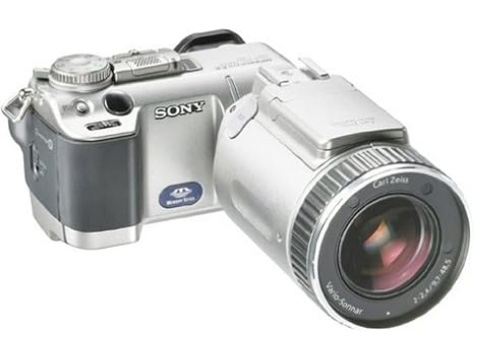    |
Among these models, the swivel-body cameras with a mechanically removable infrared-cut filter hold special creative appeal. Even today, the Sony DSC-F717—set to NightShot mode with its IR emitter blocked and a screw-on infrared pass filter mounted—delivers surreal false-color and high-contrast monochrome infrared foliage straight out of camera, as shown below:
